News ·
Royma RMLCT7500 inline CT detects stacking failures in every prismatic cell

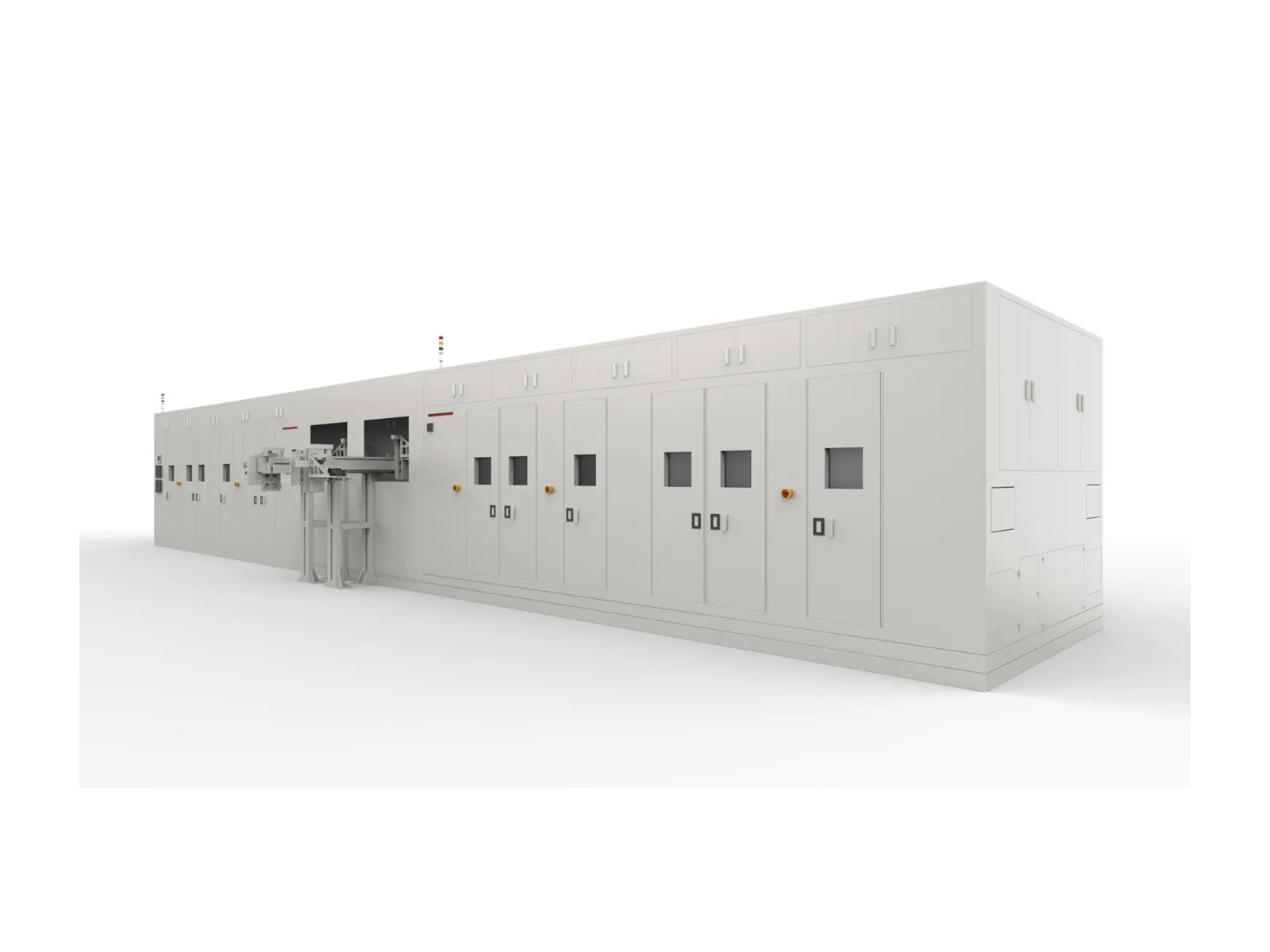
The Royma RMLCT7500 inline CT detects stacking failures in every prismatic cell, in 3D and at up to 36 ppm. For engineers planning inline CT for prismatic cell stacking, the machine delivers a defect record for each cell – and with it the basis for optimised process parameters on Z-stacking, cut-and-stack and fly-stacking lines.
Five stacking failures in one 3D inspection
The RMLCT7500 is an inline gantry CT machine for stacked prismatic battery cells. It inspects every cell fully automatically and detects the five defect types that decide whether a stack is good:
- electrode overhang at the four corners of the stack
- folded electrode edges
- crash between electrode layers
- foreign bodies inside the stack
- crinkle in the electrode sheets
A 2D X-ray image of a stacked cell shows all layers on top of each other. The overlap leads to misjudgement, both false positives and missed failures. Laboratory CT gives clear results but is too slow to inspect every cell. The RMLCT7500 combines a clear 3D view of each electrode layer with automatic defect recognition at line takt; the scanning area and the detected error types are configured for the cell design.
Stacking failures occur even within specification
Royma’s lesson from inline projects is direct: even when every process parameter is within specification, stacking failures can occur. Several factors interact. The stacking method and its speed – Z-stacking, cut and stack or fly stacking – matter, as do cold or hot pressing, electrode thickness, the phase of ramp-up and preceding steps such as coating and calendering.
Because the cause lies in the combination, a sampled laboratory check sees too few cells to show it. The RMLCT7500 records the defect type for every cell on the line. Production and process engineers can set these results against stacking speed, pressing and alignment settings and adjust the parameters on data rather than on assumptions.
“The RMLCT7500 shows each stacking failure in the cell where it occurs, at the corner or edge where it sits,” says Gabor Szabo, Sales Director Europe, Royma Europe. “That gives the process team a reliable basis to optimise stacking parameters in production, not only during qualification.”
Corner and edge scans keep the line at takt
Overhang arises at the corners of the stack, so all four corners have to be scanned. The RMLCT7500 uses a diagonal 45° scan for overhang detection and an edge scan for folded electrodes. Scanning these regions instead of the full cell volume is what makes 3D inspection fast enough for 100% inline use.
The modular gantry system takes the number of gantry rings the line requires. Throughput reaches up to 36 ppm, depending on cell thickness and the number of inspection points. The machine needs more floor space than a 2D X-ray station, which is one more reason to plan its position early.
The inspection point is designed with the line
In Royma’s experience from cell production in China, 100% inline inspection of stacked electrodes is placed mostly directly after stacking and taping, or after canning and welding. After stacking, a faulty stack is found before further value is added. After canning and welding, the check covers the stack as it sits in the closed housing.
Either position fixes handling, buffer and cycle time in the line layout. An inspection point added after the line is built has to fit around those decisions; one designed with the line sets them. For a new prismatic-cell line, the inline CT station belongs in the same planning phase as the stacking machine.
“We configure the RMLCT7500 to the cell format, the inspection points and the takt of the line,” adds Szabo. “Planned together with the stacking equipment, it inspects every cell from the start of production.”
More on CT inspection of cells and modules: Batteries.
Test scans available
Royma Europe offers test scans of customer prismatic cells and helps define the inspection point for new stacking lines. Contact Gabor Szabo, Sales Director Europe, Royma Europe, gabor_szabo@roymatek.eu, +49 15156503316 – www.roymatek.eu.
Royma Europe, Leibniz Universität Hannover – Institut für Produktentwicklung und Gerätebau, Gebäude 8143, An d. Universität 1, 30823 Garbsen, Germany.
About Royma: Royma Industrial CT develops and builds industrial X-ray and computed tomography systems, from 2D X-ray to horizontal, gantry, planar and inline CT.