News ·
Royma brings 100 % inline CT to cylindrical-cell lines with the RMCLT1850
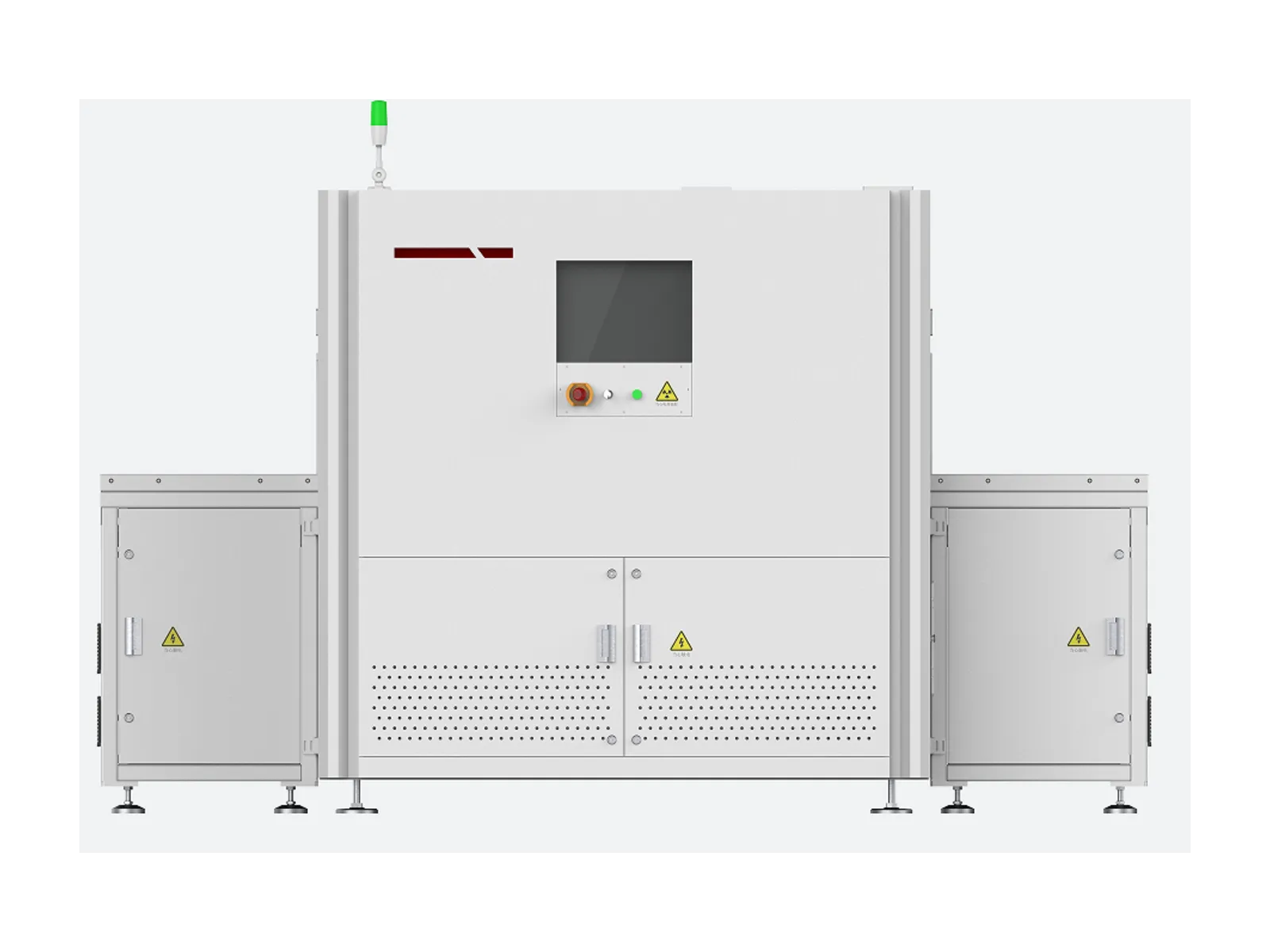
Royma brings 100 % inline computed tomography (CT) to cylindrical-cell lines with the RMCLT1850, a fully automatic CT station that scans up to six cells at once and sorts every out-of-tolerance cell from the production stream. With four parallel X-ray sources, the RMCLT1850 inspects up to 288 cells per minute in the 21700 format.
The RMCLT1850 is built for battery manufacturers who want to check every cylindrical or button cell, not a sample. It covers cells up to 170 mm long and 80 mm in diameter, which includes the 21700 and the large-format 46800 cells used in current EV and consumer production.
A complete inspection station from barcode to NG store
The RMCLT1850 is a closed line segment, not a laboratory instrument placed next to the line. Each cell passes the same sequence of stations:
- barcode scanner, so every scan result is tied to one cell
- loading robot and rotating CT fixture between X-ray source and detector
- unloading robot and automatic NG sorter
- NG storage for rejected cells
Loading, handling, scanning, analysis and sorting run without an operator. Customised fixtures hold each cell in the same position for every scan, so results from one shift can be compared directly with the next.
“With the RMCLT1850, a cell line gets a CT result for every single cell, linked to its barcode, and the defective ones leave the line automatically,” says Gabor Szabo, Sales Director Europe, Royma Europe.
Parallel scanning keeps pace with the line
The RMCLT1850 uses fast rotating CT with a 180° rotation per scan. A region-of-interest CT scan takes less than 2.8 s, and up to six cells are scanned at the same time. This is what makes 100 % CT feasible at cell-line cycle times.
Throughput scales with the number of X-ray sources. For 21700-format cells, the station uses a 225 kV open microfocus tube with a 180° scan in 3 s plus 2 s for loading and unloading. One source delivers 72 cells per minute at a stated 95 % OEE; two, three and four sources deliver 144, 216 and 288 cells per minute.
For 46800-format cells, the RMCLT1850 is configured with a 160 kV, 700 W X-ray source and a 180° scan in 15 s plus 2 s for handling. One source delivers 14 cells per minute at 95 % OEE, two sources 28 cells per minute. The configuration is chosen per cell format, so a line pays for the penetration and the throughput it needs.
Current hardware and automatic analysis work together
The RMCLT1850 combines current-generation inspection hardware with automatic evaluation software. The open microfocus source, the fast rotating fixture, the detector and the two handling robots are integrated as one station, and the software evaluates each scan and makes the sort decision without manual image review.
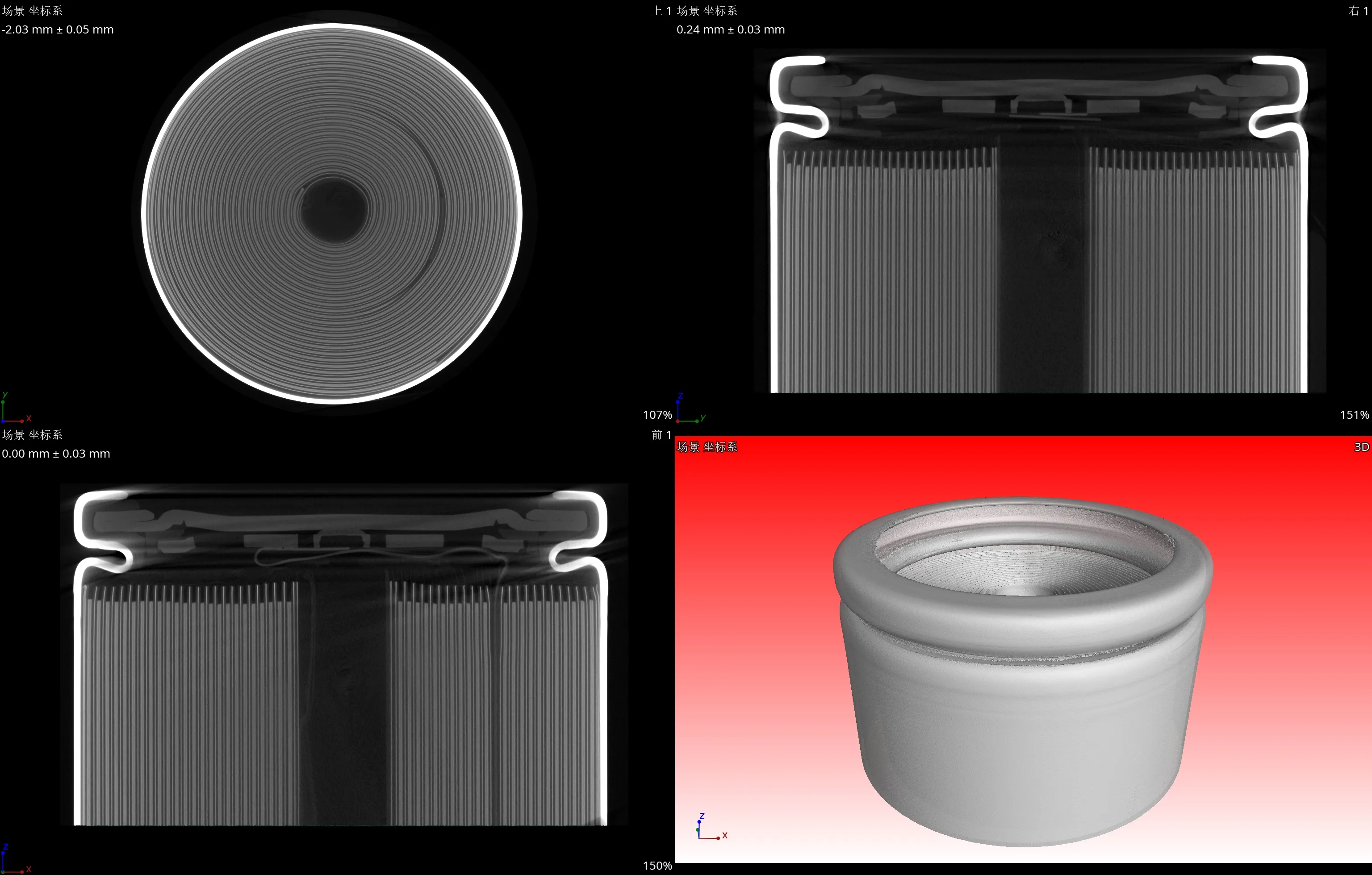
For cylindrical cells, the station reports the internal gaps between the electrodes and the can, and the electrode overhang, automatically for every cell. These are the features a quality engineer needs to see before a cell leaves the line, and they are read from a 3D data set rather than from a 2D shadow image in which several electrode layers overlap.
“We combine the X-ray hardware, the handling and the analysis software in one station, because the result only counts when all three keep up with the line,” adds Szabo. “That is how a cell line moves from periodic manual sampling to a measured result for every cell.”
From sampling to 100 % inspection
Many cell lines still take cells off the line at fixed intervals and check them in a laboratory, destructively or by 2D X-ray. That approach finds a problem only after it has already affected a batch. The RMCLT1850 turns the same check into an inline measurement: every cell is scanned, every result is stored against its barcode, and defective cells are sorted out before they reach formation, module assembly or the customer.
For lines that are moving from ramp-up to steady volume production, this gives process engineers a complete data record from the first day of series output. Trends in gaps or overhang become visible across shifts and can be traced back to winding and assembly parameters.
The RMCLT1850 belongs to Royma’s inline CT family, alongside the RMLCT7500 for prismatic cells.
Test scans of your cells
Royma Europe offers test scans of customer cylindrical and button cells and an evaluation of the throughput configuration for your line. Contact Gabor Szabo, Sales Director Europe, Royma Europe, gabor_szabo@roymatek.eu, +49 15156503316 – www.roymatek.eu.
Royma Europe, Leibniz Universität Hannover – Institut für Produktentwicklung und Gerätebau, Gebäude 8143, An d. Universität 1, 30823 Garbsen, Germany.