News ·
Royma RMLCT7500 brings 100% inline 3D cell CT beyond 12 CPM to Europe's next gigafactories before SOP
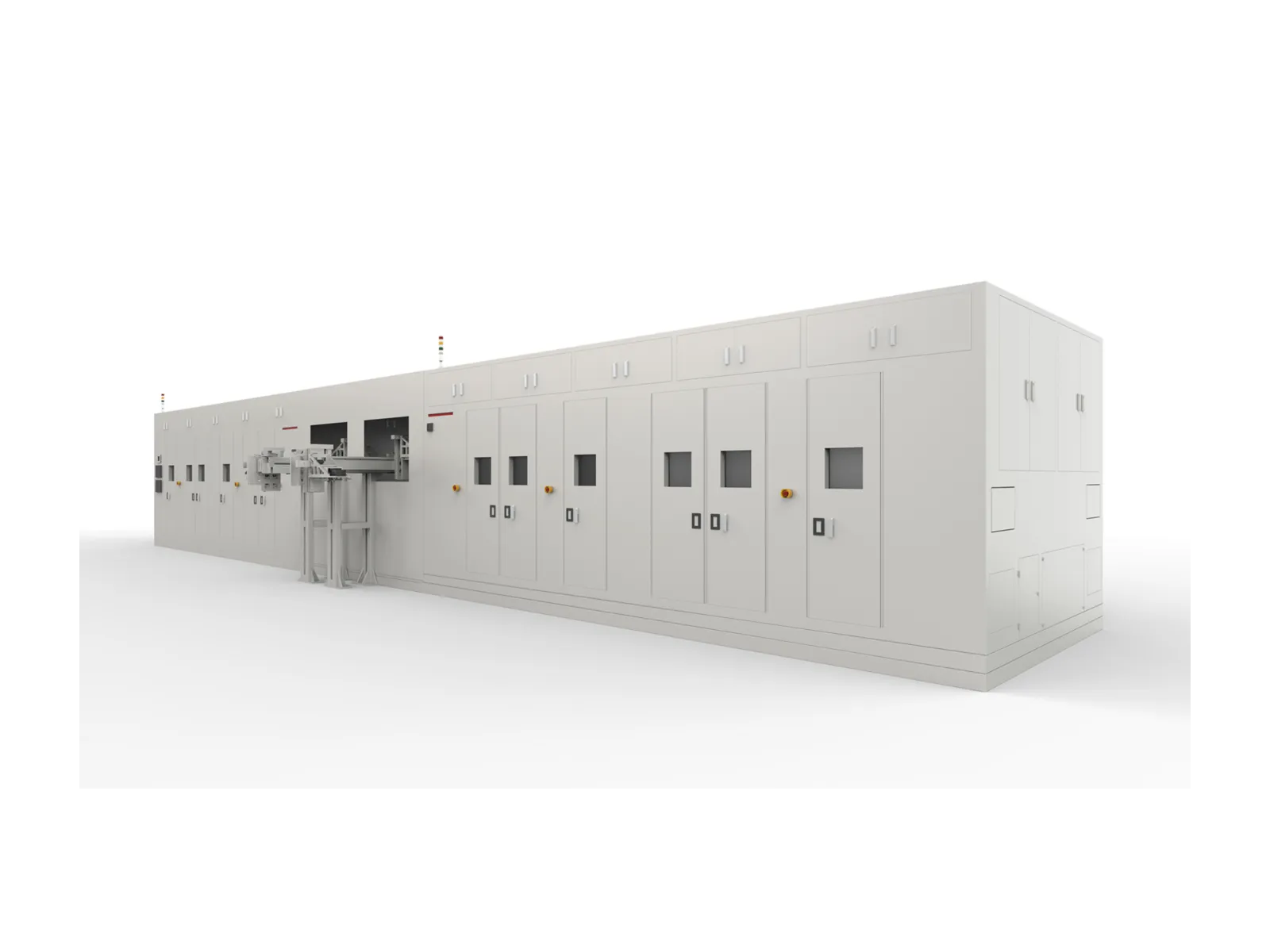
The Royma RMLCT7500 inline gantry CT inspects every prismatic battery cell in 3D at line speed, beyond 12 cells per minute and up to 36 parts per minute depending on cell thickness and inspection points. Cell factories that are specifying their line equipment now can plan 100% inline CT of electrode overhang, folded electrodes and foreign objects from the start of production (SOP), instead of relying on destructive sampling.
100% inline 3D CT belongs in the line plan, not in a retrofit
Cell factories under construction across Europe are placing their equipment orders now, and the inspection concept is decided in the same step. An inline CT station needs conveyor interfaces, floor space and a place in the takt of the line. Planned at this stage, it is part of the layout; added after SOP, it becomes a retrofit.
Royma’s experience from high-volume cell lines is that stacking failures can occur even when every process parameter is within specification. The stacking method and speed, hot or cold pressing, electrode thickness, the phase of ramp-up and the upstream coating and calendering steps all influence the result. A sampled teardown sees only a fraction of the cells, and its result arrives after the cells in between have moved on. Inline CT is therefore placed directly after stacking and taping, or after canning and welding, and all four edges of the stack are scanned.
The RMLCT7500 is built for this planning phase. It is a fully automatic machine with its own cell handling and conveyor control, and its conveyor set-up adapts to the line in linear, parallel, L-shape or S-shape variants. During the scan the cell stays in position without clamping force, while the X-ray source and detector rings move around it.
“A factory that plans its equipment now can build 3D inspection into the line from day one,” says Gabor Szabo, Sales Director Europe, Royma Europe. “The RMLCT7500 gives every cell a measured result before it moves to the next process step.”
Gantry rings scale throughput beyond 12 cells per minute
The RMLCT7500 is modular. Each gantry ring carries its own X-ray source and detector, and the number of rings is chosen to match the parts-per-minute target of the line. Throughput goes beyond 12 and up to 36 parts per minute, depending on cell thickness and the number of inspection points. A plant can size the machine for ramp-up and grow towards the cadence of full production with the same inspection method.
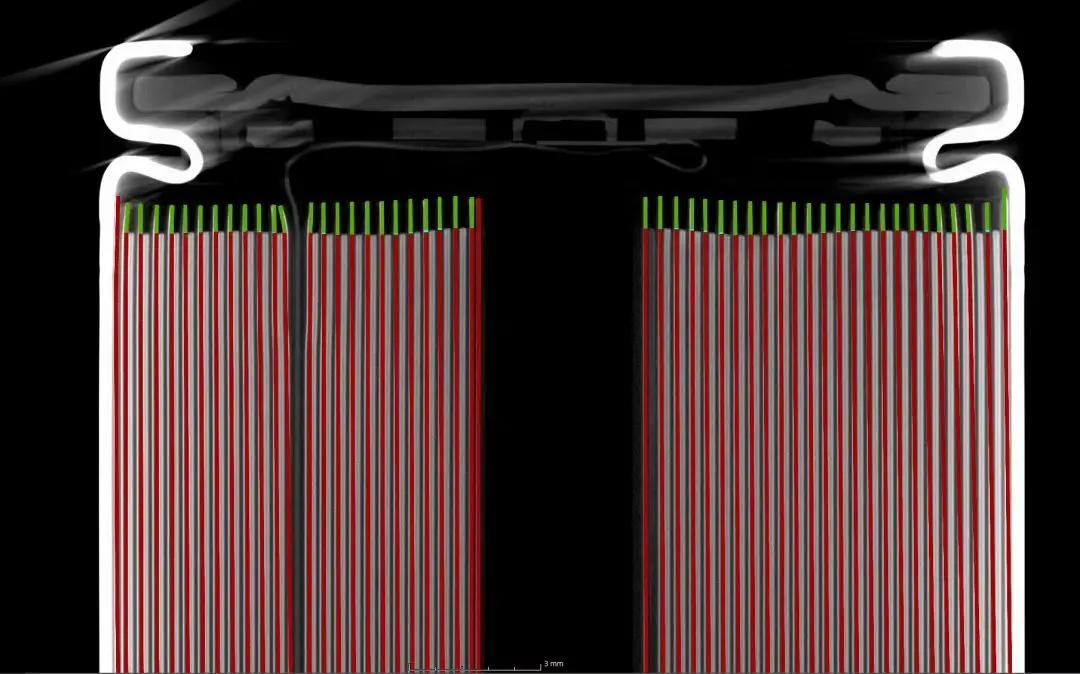
Speed comes from scanning only where stacking faults occur. A diagonal 45° corner scan measures anode/cathode overhang, and an edge scan detects folded and crinkled electrode edges. Two to six corners take 4–8 seconds, with a scan area of 64 × 64 mm per corner. Reconstruction starts while the scan is still running, so the volume is ready for analysis almost as soon as acquisition ends.
Every cell receives an automatic GO/NOGO decision
The inspection scope covers the features that decide cell safety and yield:
- anode/cathode overhang at the four corners and electrode alignment
- electrode-to-shell distance
- folded and crinkled electrode edges, punctures and cuts
- foreign objects in the electrode stack
The RMLCT7500 captures and reconstructs the images automatically. An AI-based image enhancement step sharpens the electrode edges, an overhang recognition function turns the volume into a measured distance at each corner, and proprietary algorithms classify every cell as GO or NOGO with an automatic report. Resolution is below 30 µm. For a new cell design, Royma develops customised algorithms.
Compared with 2D X-ray, which projects all electrode layers into one image, 3D data separates the layers, so overlapping edges neither hide a real fault nor create a false one. Compared with laboratory CT, the inline gantry covers every cell rather than a sample. The trade-off is floor space: an inline gantry CT needs more room than a 2D station, which is one more reason to plan it into the layout early.
“During ramp-up the process is still moving,” says Gabor Szabo. “3D data on every cell shows the process engineer which corner and which stacking step to look at, while the line is still being tuned.”
Test scans before the equipment order
Royma Europe offers test scans of customer cells on the RMLCT7500, including an evaluation of overhang, alignment and folded edges on your samples. The results confirm the scan strategy and the number of gantry rings for your line speed before the equipment is specified. More on battery inspection: Batteries · Inline gantry CT.
Contact: Gabor Szabo, Sales Director Europe, Royma Europe – gabor_szabo@roymatek.eu – +49 15156503316 – www.roymatek.eu
Royma Europe, Leibniz Universität Hannover – Institut für Produktentwicklung und Gerätebau, Gebäude 8143, An d. Universität 1, 30823 Garbsen, Germany.